



Response to the TCFD
Toyota Boshoku group is working as one team to contribute to global environmental protection for the realization of a sustainable society, based on our Corporate Philosophy to “Promote corporate activities that help protect the global environment.”
We formulated the 2050 Environmental Vision in fiscal 2017 and identified our Materiality (important issue to be resolved through our business operations) of “Together with our business partners, we will realize MONOZUKURI innovations that minimize environmental stress” in fiscal 2021 in order to promote environmental initiatives. In response to evolving social trends, we revised a part of the 2050 Environmental Vision in fiscal 2024.
In April 2020, we endorsed the recommendations of the Task Force on Climate-related Financial Disclosures (TCFD). By extensively analyzing the impact of climate change on our business and the risks and opportunities that result from it based on scenarios, we are reviewing the applicable costs required and reflecting countermeasures in our management strategy. Based on the results of scenario analysis, we will continue to strengthen our response to risks and opportunities and work on further information disclosure.
Governance
Concrete measures related to climate change and other environmental issues are decided upon by the Board of Directors and implemented. Then the progress of these measures is reported at the Corporate Strategy Meeting, the Corporate Planning Meeting, and the Corporate Management Meeting.
Policies and plans to respond to environmental issues discussed and decided at the Board of Directors, the Corporate Strategy Meeting, and the Corporate Planning Meeting are shared at the Environment Promotion Meeting, which is held three times annually, and is connected with implementation planning and progress management for environmental issues affecting the Toyota Boshoku group. Additionally, KPIs are defined based on implementation planning, and these are reported and subjected to management review at monthly Corporate Management Meetings.
Matters reported and discussed upon at the Environment Promotion Meeting are reported to the Board of Directors as needed, whose decisions and supervision allow such matters to be incorporated into group strategy.
Strategy
Scenario analysis on climate-related risks and opportunities
1. Scenario analysis results
We have identified short-term, medium-term, and long-term risks and opportunities based on the 1.5 and 2°C scenario*1 developed by the International Energy Agency (IEA), in which the impact of transition to a low-carbon society is tangible, and the 4°C scenario*2 developed by the Intergovernmental Panel on Climate Change (IPCC), in which the physical impact becomes apparent. The table below lists the risks and opportunities that are assessed as particularly high.
- 1.5°C scenario: Net Zero Emissions (NZE), in which greenhouse gas (GHG) emissions reach net zero by 2050 (IEA World Energy Outlook 2021); 2°C scenario: Sustainable Development Scenario (SDS), in which the rise in atmospheric temperature by 2100 is kept to below 2°C (IEA World Energy Outlook 2021)
- 4°C scenario: The Representative Concentration Pathways (RCP) scenario with the highest volume of GHG emissions, where the rise in atmospheric temperature by 2100 is approximately 4°C (RCP 8.5) (IPCC 5th Assessment Report)
Identified risks and opportunities
In our assessment of financial impact, we identified important risks and opportunities as events whose respective scores, when multiplied together, produce a value of 6 or higher, using four levels of “likelihood of occurrence,” and three levels of “financial impact.”
| Causes | Risk impact level | Business impact | Likelihood of occurrence Low (0,1,2,3) High |
Business impact Small (1,2,3) Large |
|
|---|---|---|---|---|---|
| Transition risks (1.5 and 2°C) |
Enhancement of climate change policies, including carbon pricing | Procurement |
|
3 | 2 |
|
3 | 3 | |||
| Direct operations |
|
3 | 3 | ||
| Enhancement of efforts to promote vehicle electrification | Product demand |
|
3 | 2 | |
|
3 | 3 | |||
| Change in evaluation by customers and the consumer value standard (raised environmental awareness, etc.) |
|
3 | 3 | ||
|
3 | 3 | |||
|
3 | 3 | |||
|
3 | 3 | |||
| Physical risks (4°C) |
Worsening of extreme weather, including heavy rain and subsequent flooding | Procurement |
|
3 | 2 |
| Direct operations |
|
3 | 2 |
Impact assessment and results
We compiled the actions to address the identified risks and opportunities, and their single-year costs.
| Causes | Risks / Opportunities | Assessment | Actions | Response Cost (FY2025) | |
|---|---|---|---|---|---|
| Transition risks (1.5 and 2°C) | Enhancement of climate change policies, including carbon pricing |
|

|
|
― |
|
|
|
2.2 billion yen | ||
|
|
|
|||
| Enhancement of efforts to promote vehicle electrification |
|

|
|
1.0 billion yen | |
|
|
|
2.7 billion yen | ||
| Change in evaluation by customers and the consumer value standard (raised environmental awareness, etc.) |
|
|
|
1.7 billion yen | |
|
|
||||
| Physical risks (4°C) | Worsening of extreme weather, including heavy rain and subsequent flooding |
|
|
|
― |
|
|
|
0.3 billion yen |
2. Priority action
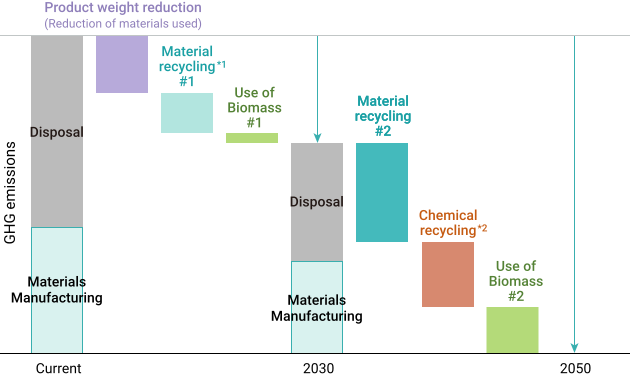
Tackling carbon neutrality through advancement of a circular economy for product materials
The Toyota Boshoku group promotes the reduction of GHG emissions in the product life cycle.
In addition to reducing the weight of products, using plant-derived materials (biomass), and developing technologies for electrified products, we are improving the recyclability of products. We will also work to reduce GHG emissions from the materials used in our products toward achieving carbon neutrality.
1) Measures to reduce GHG emissions from product materials
2) Initiatives for a circular economy
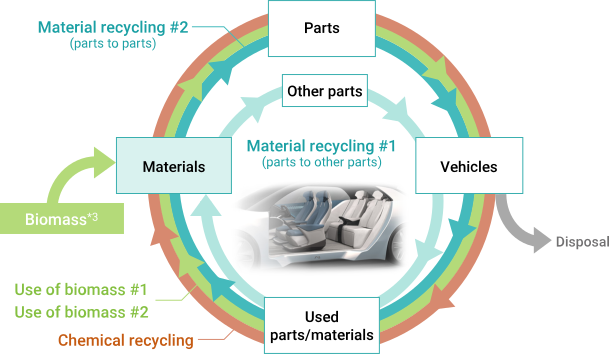
Challenge to carbon neutrality by 2050 by recycling product materials and using biomass
- Reusing products as raw materials to produce new products
- Chemical decomposition of used products and reuse as raw materials for new products
Risk Management
The Carbon Neutral Environmental Center monitors climate change-related changes in the external or internal environment for the entire Toyota Boshoku group, and identifies risks that could negatively impact our business.
Climate-related risks are identified at the Risk Management Promotion Meeting, with the Chief Human Resource Officer (CHRO), head of the Human Resources & General Administration Segment, acting as chairperson. The Risk Management Promotion Meeting receives reports from various departments, including the Carbon Neutral Environmental Center, and discusses climate change-influenced risks of all kinds, such as typhoons and flooding. Judgments are made concerning the relative severity of risks, with consideration made to the relationship between various risks. Finally, climate-related risks which affect the Toyota Boshoku group are identified.
Identified risks are reported to the Board of Directors, under the management of the Chief Risk Officer (CRO) who is also the President.
Metrics and Targets
The Toyota Boshoku group is working to reduce GHG emissions in accordance with the 2050 Environmental Vision.
The 2030 Environmental Action Plan targets a 50% reduction in factory GHG emissions and a 30% reduction in logistics CO2 emissions by 2030 compared to fiscal 2020.
In addition, we aim to reduce factory GHG emissions by 100% from the fiscal 2020 level as our 2035 stretch goal.
Medium- and long-term targets
- 2030 Target
50% reduction in plant GHG emissions versus FY2020 - 2035 Challenge Target
Aim for a 100% reduction in plant GHG emissions versus FY2020 -
2050 Environmental Vision
GHG Net-zero in the product life cycle
GHG Net-zero in the plant
Monitoring metrics
- Scope 1and 2 GHG emissions and energy usage (Toyota Boshoku group)
- Scope 3 GHG emissions (Toyota Boshoku group)
FY2025 results