



Job Satisfaction and Employment
Basic Concept of Human Resources Management (HRM)
With a good relationship between labor and management as a vital foundation, the Toyota Boshoku group aims to both guarantee stable employment and to maintain and continue improving working conditions into the mid- and long-term future. To achieve this, we are working to ensure consistent and thorough communication between labor and management—including but not limited to labor-management meetings—with each sharing plans, issues encountered, and other relevant information to ensure that both are able to fulfill their respective responsibilities. In addition, the Toyota Boshoku group works to develop human resources and provide appropriate employment conditions by conducting fair and equitable evaluations that use standards reflecting our core values. We strictly respect the laws and regulations of every country and region we operate in, whether they concern working hours, days off, wages, or other basic working conditions.
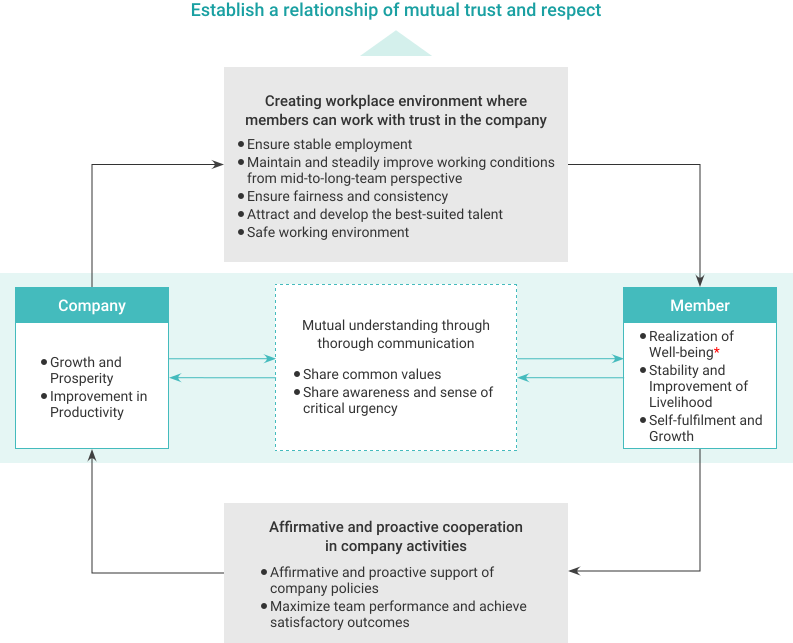
- Being in a good state physically, mentally, and socially, with individual rights and self-fulfillment ensured
Pursuing Ease of Working
With regard to working hours, we strictly respect the Labor Standards Act (a law that governs working conditions in Japan), and make sure to carry out all appropriate legally mandated procedures in the event that a company member works longer than the designated duration of legal working hours. Additionally, from a health management perspective, we are aiming to curb long working hours and reduce excessive overtime.
To help reduce excessive working hours, We are implementing the following initiatives in an effort to improve members' awareness of time management.
- Implement periodic company-wide training on time management
- Appoint a labor management promoter in each division and build systems for proper working hour management in each workplace
- Conduct investigations of all discrepancies between objective records of actual starting and ending times and self-reports in the attendance management system
As company-wide initiatives to improve operational efficiency, we are promoting the following activities:
- Document simplification activities
- Meeting streamlining activities
- Use of digital tools (e.g. robotic process automation (RPA))
Employee engagement
From fiscal 2025, we revamped our survey method from the previous employee survey to the Toyota Boshoku EX (Employee Experience) Survey, which enables analysis at each workplace and benchmarking against other companies. In addition, the positive response rate for employee engagement, which indicates the willingness to voluntarily contribute to the organization and to our performance goals, has been set as a KPI. By effectively linking employee feedback to human resource strategy, countermeasures, and workplace improvement, and by enhancing employee engagement, we will promote the creation of an open workplace in which company members with diverse values and perspectives can cooperate and grow together.
Employee engagement positive response rate [Toyota Boshoku]
![Graph:Employee engagement positive response rate [Toyota Boshoku]](/_assets/img/sustainability/social/employees/img2026_2_01@global.svg)
Trend of annual paid holiday utilization rate
The paid holiday utilization rate has remained high, exceeding 95% in the most recent five-year period. In fiscal 2027, the company target continues to be the non-elimination of accrued paid holiday (encouraging members to take paid holiday within the validity period) or 14 days of paid holiday per year for union members, and 14 days of paid holiday per year for managers and supervisors, with labor and management working together to encourage the utilization of such leave.
Annual paid holiday utilization rate (%) [Toyota Boshoku]
![Graph:Annual paid holiday utilization rate (%) [Toyota Boshoku]](/_assets/img/sustainability/social/employees/img2026_2_02@global.svg)
- Excluding members on leave and members on overseas assignment
- Ministry of Health, Labour and Welfare: General Survey on Working Conditions
- Please note that percentages shown may exceed 100%, as the total is calculated by dividing the total number of paid holidays taken in a year (including paid holidays carried over from the previous fiscal year), divided by the total allowance of paid holiday for this year only (i.e. not including paid holidays carried over from the previous fiscal year)
Wages
The Toyota Boshoku group respects the concept of equal pay for equal work and fully complies with minimum wage standards and other laws and regulations of each country and region. We apply consistent remuneration standards regardless of gender, and there is no difference in pay for members with the same grade and job level. Management also confers with labor organizations to ensure wage levels support an adequate standard of living for company members and their families.
As part of our compensation system, Toyota Boshoku has introduced a performance-linked scheme in which bonus payment levels for manager (G3) and above are determined based on the company's performance in the previous fiscal year. Bonus payment levels for union members are also determined based on company performance, through labor-management discussions.
Bonus amounts are determined by reflecting the six-monthly performance of the individual's assigned duties in addition to company performance. By reflecting both company and individual performance in compensation, we aim to raise awareness of the need to improve performance and achieve goals, and to provide members with a sense of growth and motivation.
Housing support system
As well as providing financial assistance for home purchases and offering dormitories for unmarried company members, we have introduced a housing allowance system for members who move into rental properties after getting married. We offer support programs tailored to a variety of lifestyles, from the point a member joins the company until they own a home.
We also provide assistance for the cost of managing homes left vacant due to overseas assignment, as well as support for housing and daily living at the assignment location. Even for transfers within Japan, we provide financial assistance not only for housing costs at the new location but also for relocation and contract-related expenses.
Retirement benefit system
Toyota Boshoku has established a lump-sum retirement benefit plan, a corporate pension fund plan, and a defined contribution pension plan. Under the corporate pension fund plan, employees can choose from several benefit options, including lump-sum annuities, fixed-term annuities (15, 10, or 5 years), and a lifetime annuity with a 20-year guarantee. This guaranteed lifetime annuity allows beneficiaries to receive payments for life, and ensures that their surviving family members continue to receive benefits if the beneficiary passes away within 20 years of commencement. This helps to ensure the security and stability of company members' lives during retirement. The defined contribution plan also allows for the mobility of human resources by offering a choice of products and savings amounts, and the ability to take the plan with you even if you change jobs. Through these initiatives, we have put in place a system that allows members to play active roles at Toyota Boshoku over a long period of time with peace of mind.
Employees' Shareholding Association
Our aim is to support employees in building long-term wealth, so as to achieve financial well-being. The Association launched in 1977 as a shareholding association of Toyoda Boshoku. Funds are contributed from salary and bonus to purchase the Company's shares.
Permanent employees and post-retirement rehired employees are eligible for this scheme. The incentive provided by the Company is 10% of the contributions, and the dividends are reinvested to fund the purchase of shares for each association member. As of April 30, 2026, the participation rate was 61%. In addition, since April 2026, employees of affiliated companies have also been able to contribute to the Shareholding Association, and in this way we are working to improve financial well-being across the entire Toyota Boshoku group.
Graduate and Mid-career Recruitment
New graduate recruitment
Our policy is to recruit highly capable individuals with diverse attributes and values in an active and stable, sustainable manner. We will establish a recruitment framework by field and systematically develop individuals with aptitude after they join the company, building a system that will enable them to become an immediate asset.
In addition, we have introduced course-specific hiring, in which applicants are assured of their initial post-joining assignment at the time of their job offer.
We also hold in-person divisional briefings to help them better understand the workplace. By asking them about their preferred division through interaction with senior company members, we strive to minimize mismatches after assignment.
Mid-career recruitment
In order to achieve our Mid-Term Business Plan, we are hiring people with advanced specialized skills, such as digital transformation (DX) and environment-related technologies. In addition to agency recruitment and direct recruitment, we use referrals from company members and alumni hiring to efficiently hire talented people and people who are well versed in our culture and operations. Additionally, we are building an environment where the same opportunities for training and promotion are available to all company members, regardless of when or how they joined the Company. In the future, we will focus on implementing new initiatives alongside our regular work acquiring talented people with different backgrounds, experience, and knowledge, who can bring added value to our company's business.
Number of persons recruited
| Item | Total scope | Unit | FY2022 | FY2023 | FY2024 | FY2025 | FY2026 | ||
|---|---|---|---|---|---|---|---|---|---|
| Graduate recruitment | Administrative and engineering | Men | Toyota Boshoku | People | 58 | 80 | 135 | 153 | 92 |
| Women | Toyota Boshoku | People | 20 | 25 | 49 | 30 | 30 | ||
| Skilled | Men | Toyota Boshoku | People | 48 | 51 | 60 | 61 | 84 | |
| Women | Toyota Boshoku | People | 9 | 12 | 14 | 16 | 17 | ||
| Ratio of women | Toyota Boshoku | % | 21.5 | 22.0 | 24.4 | 17.7 | 21.1 | ||
| Total | Toyota Boshoku | People | 135 | 168 | 258 | 260 | 223 | ||
| Mid-career recruitment* | University graduates | Men | Toyota Boshoku | People | 1 | 19 | 64 | 110 | 71 |
| Women | Toyota Boshoku | People | 8 | 7 | 17 | 29 | 9 | ||
| Graduates of high school or vocational school | Men | Toyota Boshoku | People | 0 | 0 | 4 | 10 | 8 | |
| Women | Toyota Boshoku | People | 0 | 0 | 0 | 2 | 4 | ||
| Employees recruited as mid-career, as percentage of total number of employees recruited per year | Toyota Boshoku | % | 6.3 | 13.4 | 24.8 | 36.7 | 29.2 | ||
| Total | Toyota Boshoku | People | 9 | 26 | 85 | 151 | 92 | ||
| Graduate + mid-career recruitment Total | Toyota Boshoku | People | 144 | 194 | 343 | 411 | 315 | ||
- The number of mid-career hires for skilled positions is not included
Human Resource Retention Activities
In recent years, there has been increased mobility of human resources, and the employment market and workers' attitudes have also changed. However, the turnover rate at Toyota Boshoku is below the industry-wide average due to our pursuit of ease of working, including the enhancement of the workplace environment and systems.
Since about 60% of company members who leave the company are new graduate hires, as activities to retain new company members we implement “assignments that take into account the individual's wishes, personal aptitude, and subject major,” “post-assignment questionnaires and individual interviews,” and “three-way meetings with supervisors and senior company members using a training record chart." In addition, to ensure smooth communication with new company members, direct supervisors and senior company members undertake "communication skills training.” We believe that this training also has a positive impact on subsequent on-the-job training activities, and helps to maintain the motivation of new company members.
Turnover rate trend (full time company members)
| Item | Total scope | Unit | FY2022 | FY2023 | FY2024 | FY2025 | FY2026 | |
|---|---|---|---|---|---|---|---|---|
| Voluntary turnover rate | Toyota Boshoku | 人 | 110 | 143 | 155 | 151 | 92 | |
| Toyota Boshoku | % | 1.17 | 1.62 | 1.75 | 1.67 | 1.00 | ||
| Turnover rate of new graduates leaving within 3 years | Toyota Boshoku | % | 8.3 | 9.9 | 6.3 | 9.4 | 6.6 | |
| Administrative and engineering | Toyota Boshoku | % | 6.5 | 8.9 | 2.4 | 12.7 | 3.8 | |
| Skilled | Toyota Boshoku | % | 11.1 | 11.9 | 10.7 | 5.1 | 11.7 | |
Treatment of Non-regular Workers
Employment of non-regular workers is conducted in compliance with labor laws and regulations, and employment conditions, including social insurance and work leave, are provided in accordance with employment rules and regulations. We also ensure that employment conditions for non-regular workers are reasonably comparable to permanent company members. In addition, the employment of temporary workers is conducted in accordance with the Worker Dispatching Act, Guidelines for Measures to be Taken by Clients, and other laws and regulations.