


Environmental Management
Basic Approach
The Toyota Boshoku group implements environmental management activities on an on-going basis that include convening sessions for environment-related meetings and committees in the respective regions worldwide to confirm progress on environmental initiatives, verifying cases of improvement via genchi-genbutsu (Go, see & study) and actively implementing cross-organizational deployment best practices. In addition, we are providing education to people inside and outside the organization focused on environmental protection.
Promotion of Environmental Management
In April 2023 we appointed a Chief Carbon Neutral Officer (CCNO) in order to further promote our carbon neutrality initiatives. The Toyota Boshoku group is cooperating across various global regions, including with various working groups in the Japan region and other regions, to promote activities designed to help achieve 2050 Environmental Vision.
Environmental management promotion system
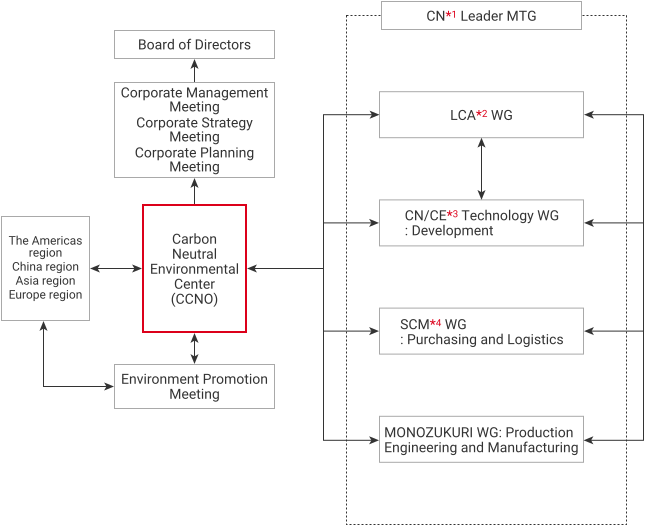
- Carbon Neutral
- Life Cycle Assessment
- Circular Economy
- Supply Chain Management
Environment Promotion Meeting
A meeting with the goal of sharing information, setting goals, following-up, and globally promoting initiatives designed to achieve Toyota Boshoku group's Environmental Vision.
Participating members: All Chief Officers, including the President
Frequency of meetings: three times annually
Main issues discussed: Expansion of approach and action plans aimed at meeting the Environmental Action Plan's various targets, as well as evaluation of progress made towards these targets.
- 1. Approach towards issues and initiatives for reduction of Greenhouse Gas (GHG) emissions in the value chain
- 2. Strategy-led action plan, such as energy savings, renewable energy, carbon offsets, emissions management, etc.
Regional Committee Activities
Committees in each region work together with the Environment Promotion Meeting to promote activities designed to help meet the targets of the 2025 Environmental Action Plan.
At this time, the following four environmental activities are marked as priorities:
- 1. Activities to ensure zero non-compliances and complaints*
- 2. Activities related to ISO 14001 certification
- 3. Activities for the management of chemical substances at plants
- 4. Activities to reduce environmental impact
Although the environmental issues being dealt with at the state and regional level differ, the Toyota Boshoku group has set high standards for all of its activities, which can be managed and implemented by each committee.
- Non-compliances: In case oil, etc. has leaked into a public waterway at a level that exceeds legal, by law and agreement standard values
Complaints: In case of contact from a local citizen, government, etc., alleging physical damage or psychological effects on account of the company
Initiatives for Legal Compliance / Environmental Non-Compliance
We have set voluntary standards that are stricter than those of environmental-related laws and ordinances, and manage the status of compliance, whereby we prevent environmental accidents and pollution. In addition, we conduct risk management with value placed on the perspective of local people. Our environmental risk map is used in this regard. An environmental risk map is a tool to visualize risk around a plant and on premises, strengthen inspection standards and enable environmental patrols. Responsible persons at each plant carefully visualize risk and conduct patrols so that the latest information is always incorporated into the risk map.
In fiscal 2025, Toyota Boshoku group had no environmental accidents, violations, or abnormalities.
ISO14001
All business entities in Japan completed the transition to ISO 14001:2015, the new version of the standard, in fiscal 2019. In fiscal 2025, we conducted internal and external audits at each site and completed our ISO14001 activities.
External audits
In fiscal 2025, we also were systematically examined by certification institutions in each country and region. All of the target factories were evaluated as "There were no nonconformities, and the requirements of ISO14001 are being properly operated."
Environmental Risk Management
Creating a management system for chemical substances
The Toyota Boshoku group is taking steps to manage chemical substances in all business activities from development and design to production and packaging.
Table of managed substances
| Management area | Product | Packing/packaging materials | Work environment Surrounding environment |
||||
|---|---|---|---|---|---|---|---|
| Development / Design | Mass-produced products | ||||||
| Material classification | With indications on drawing |
Component 
|
 |
 |
|||
| Raw materials making up product |
Without impact on the environment 
|
||||||
|
With impact on the environment 
|
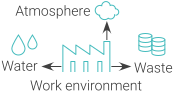 |
||||||
| Without instructions on the drawing | Secondary materials |
Possibility of mixture in product, added to product 
|
|||||
|
Possibility of mixture in product not added to product 
|
|||||||
|
Packaging, and packaging materials 
|
 |
||||||
Activities to reduce emissions of chemical substances
In order to both prevent damage to the environment and protect the safety and health of the company members, the Toyota Boshoku group has created a list of “Toyota Boshoku Controlled Substances.” This list contains various chemical substances used in production which are either currently under restrictions or which may face restrictions in the future. Additionally, certain chemical substances that pose significant risks of harm to humans or to the environment, or which are subject to prohibitions on their production, have been designated “Toyota Boshoku Banned Substances,” and their use prohibited.
Regarding VOC*1 and PRTR*2-target substances—both of which are classified as Toyota Boshoku Controlled Substances—the Toyota Boshoku group has reduced emissions by switching to water-based paint and by starting to transition to release agents that contain low amounts of VOC and PRTR substances. Moving forward, we will continue to promote activities aimed at reducing the amount of chemical substances used and the amount of emissions from our plant.
Furthermore, the Group prohibits the use of CFCs, which are ozone-depleting substances, and does not use them.
- VOC: Volatile Organic Compounds (encompassing 100 substances designated by Japan's Ministry of the Environment)
- PRTR: Pollutant Release and Transfer Register
PRTR substances / VOC emissions [Toyota Boshoku]
![Graph:PRTR substances / VOC emissions [Toyota Boshoku]](/_assets/img/sustainability/environment/management/manage/img5_3_01@global.svg)
Soil and groundwater contamination prevention initiatives
Toyota Boshoku makes continual efforts to prevent any contamination of soil and groundwater.
In 1996 an organochlorine substance was detected at above designated maximum levels at one of our business sites. After completion of the necessary cleanup continuous monitoring of the area was put in place. As well as this, explanations as to the monitoring situation were provided to local community meetings, and periodic reports were made to the relevant government agencies.
Additionally, cleanup of soil contamination identified at other site in 2008 and 2018 was successfully carried out via excavation and removal of the affected soil.
Furthermore, Toyota Boshoku group carries out examination of sites (such as when acquiring new business sites or beginning construction of new plants) in line with the relevant laws and regulations of each country and region in question.
Results of trichloroethylene measurements in fiscal 2025 (Environmental standard: 0.03mg/ℓ)
(Unit: mg/ℓ)
| Name of plant | Concentration in groundwater within grounds | Current status |
|---|---|---|
| Kariya Plant | FY2023:ND*–0.007 FY2024:ND–0.003 FY2025:ND |
Below standard values Continuing to maintain |
- ND: Not detectable; under minimum quantity value (less than 0.002)
PCB treatment status
Polychlorinated biphenyls (PCBs) are now designated as substances prohibited by law. PCB wastes now being stored must be treated at designated treatment facilities no later than the end of March 2027.
In response to this, Toyota Boshoku completed treatment of all remaining PCB wastes in fiscal 2022.
Our Business Activities and the Environment
Resource water withdrawal for business activities and emissions causing environmental impact
We quantitatively monitor resource water withdrawal, including energy, water, etc. (INPUT), and the environmental impact of GHG emissions (OUTPUT). We are promoting activities to reduce the environmental impact accompanying our business activities, and contributing to the realization of a sustainable global environment.
Resource water withdrawal for business activities and emissions causing environmental impact in fiscal 2025
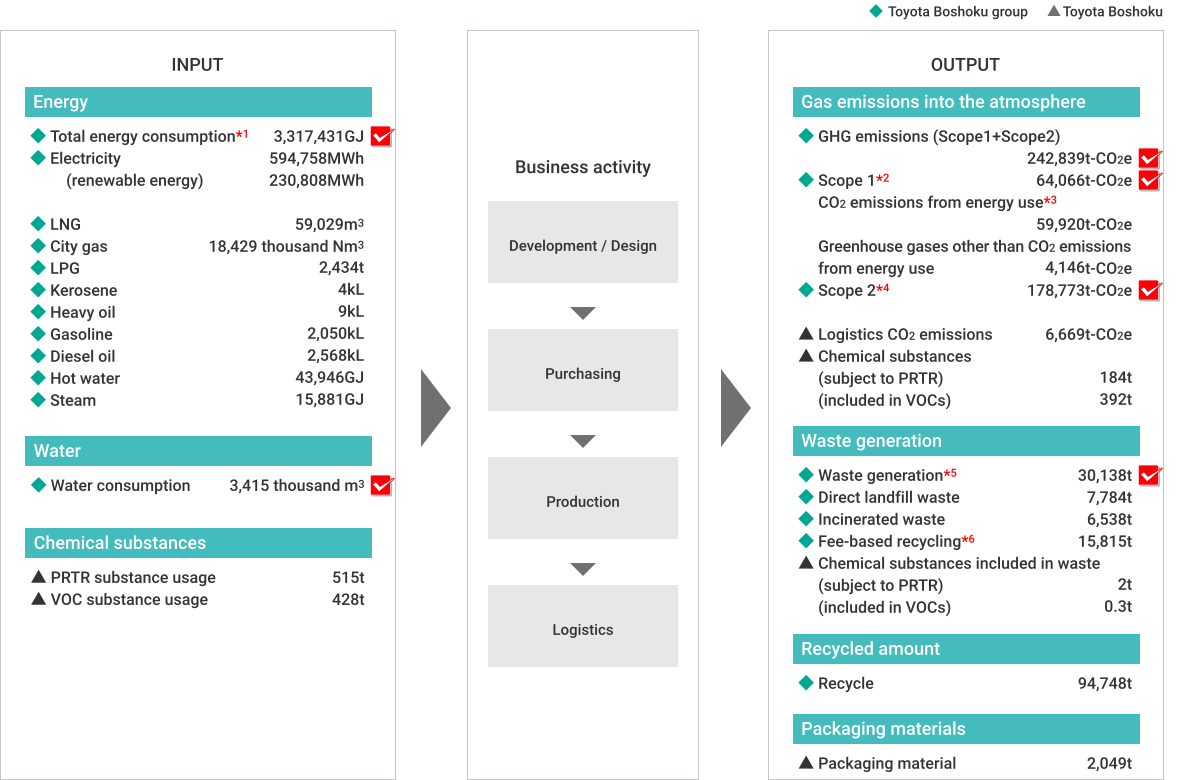
- The sum total of the values given by multiplying the consumption of each category of energy by its corresponding unit of energy generation. For units of energy generation (excluding electricity usage), we use values from Japan’s Ministry of the Environment’ s “List of Calculation Methods and emission factors with Regards to the Systems of Calculation, Reporting, and Announcements” (no official English translation could be found), with 1 MWh of electricity usage converted to 3.6 GJ, and the results aggregated.
- Since fiscal 2023 calculations have made use of data for the so-called “6.5 gases” (i.e. greenhouse gases other than CO2 emissions from energy use), as well as CO2 emissions from fuel used by Toyota Boshoku group vehicles.
- Direct greenhouse gas emissions from a company’s own fossil fuel combustion and industrial processes. Scope 1 emissions from the Toyota Boshoku group occur from the burning of LNG, city gas, LPG, kerosene, heavy oil and diesel oil.
- Indirect emissions from the generation of electricity, heat and steam purchased from other companies. Scope 2 emissions from the Toyota Boshoku group occur from the generation of purchased electricity, steam, and hot water.
- The amount of construction waste (718t) produced by subsidiary construction companies is not included here.
- Waste that is recycled for a fee
The “ ” Assurance symbol on volumes of Toyota Boshoku group's energy and water withdrawal, GHG emissions (Scope 1, Scope 2, and Scope 3), and waste emissions shown on our web pages indicates third-party assurance from KPMG AZSA Sustainability Co., Ltd.
For details, refer to the Independent Assurance Report.
Strengthening Environmental Education to Pass Environmental Conservation Activities on to Future Generations
Environmental education
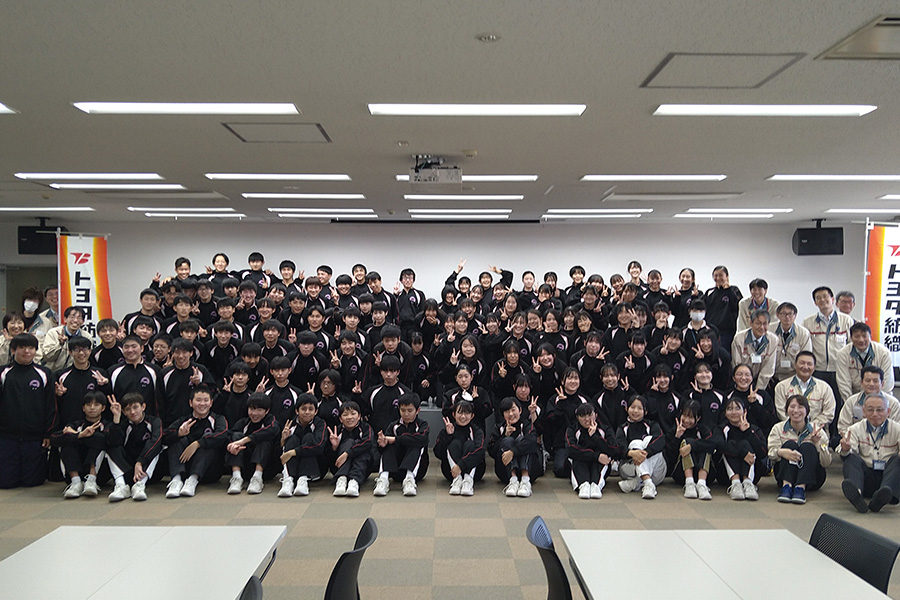
Toyota Boshoku provided an opportunity to have fun learning about the environment by conducting on-site education at local elementary and junior high school. Since fiscal 2024, an exchange with Fujioka Minami Junior High School began when Toyota Boshoku purchased electricity generated by the school's solar power generation equipment as a Green Power Certificate*1, using it at Toyota Boshoku's Technical Skills Training Center. In October, 2024, we participated in the Fureai Festival held in the Fujioka area as a collaborating company of first-year students at Fujioka Minami Junior High School. We had six prior meetings with the students, and after they had gained an understanding of our environmental activities, headed to the actual Fureai Festival. At the Fureai Festival, we held a craft class together with junior high school students, where they made coin cases and keychains from off-cuts of our seating materials, and accessory cases using discarded filters.
We also welcomed first-year students from Fujioka Minami Junior High School to the Toyota Boshoku Technical Skills Training Center for an exchange meeting with Toyota Boshoku company members. After giving the students a chance to see for themselves and experience Karakuri*2 devices, we introduced them to Toyota Boshoku's initiatives related to the SDGs.
The aims of these activities are to have junior high school students, who will be the leaders of the next generation, experience the SDG initiatives of a company that is well known to them, and learn the importance of acting with an awareness of the SDGs.
Going forward, we will continue our exchange with Fujioka Minami Junior High School.
(Exchanges with local elementary and junior high schools were held seven times up until fiscal 2020; not held between fiscal 2021 and fiscal 2023 due to the coronavirus pandemic)
- Green Power Certificates are issued as a means of trading the environmental value of green power, separately from the electricity. Purchasing a Green Power Certificate allows the purchaser to be deemed to have used green power generated from renewable energy sources.
- Simple equipment powered with natural energy instead of electricity etc., used to remediate issues in the plant workplace
Initiatives in the local community
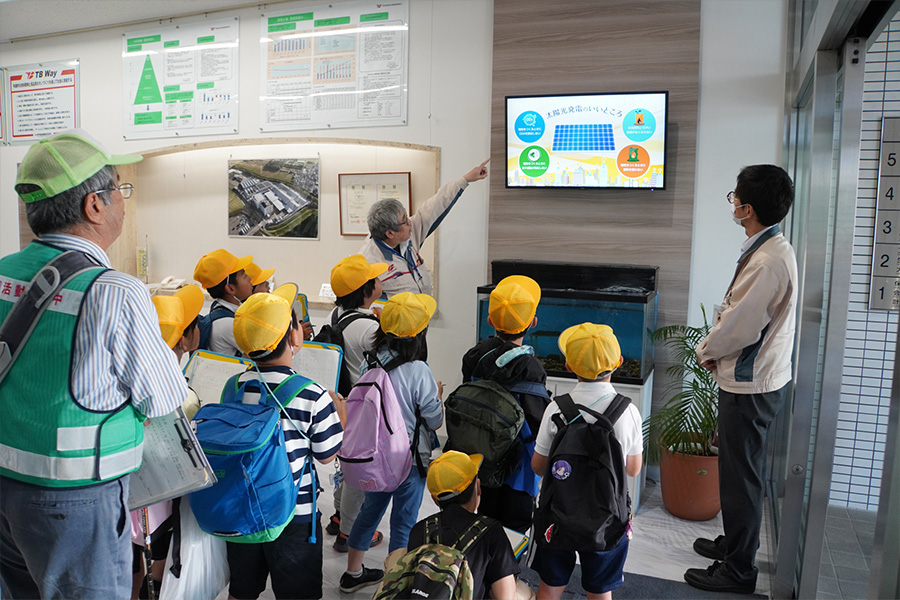
Since 2020, Toyota Boshoku has accepted social studies field trips at its Takaoka Plant by third-year students from Toyota City Tsutsumi Elementary School. We share the current status of global warming with the children and introduce the initiatives underway at the plant for solar and wind power generation.
Going forward, we will continue to help the community to better understand the environment, to realize a sustainable global environment.
Internal environmental training
Toyota Boshoku carries out environmental training for company members in order to further improve their awareness of environmental issues.
Alongside training for new company members and members facing promotion, we engage in various other initiatives. For example, we run environment-related events annually during Environment Month in June, as well as various training initiatives, such as e-learning and ISO14001 training.
Conducting Environmental Lectures during Environment Month
The environment lecture held in fiscal 2025
Date: June 2024 (Environment Month)
Lecturer: Mr. Yutaka Yamamoto (Nature Conservation Office Chief, Wild Bird Society of Japan)
Lecture Topic: Biodiversity conservation and the plastic marine debris issue
Lecture content: The weight of plastic debris in the ocean is forecast to exceed the weight of fish by 2050. He explained how plastic debris is mistakenly consumed by seabirds and mammals, leading to the risk of death, including actual examples.
Working with and contributing to society
Toyota Boshoku collaborates with other industries through the Japan Auto Parts Industries Association (JAPIA) to promote activities aimed at achieving carbon neutrality throughout the value chain.
We also actively participate in the Environmental Partnership Organizing Club (EPOC)-a partnership composed of around 250 large corporations in Japan’s Chubu region. Through our participation in EPOC activities, such as inspections and workshops, we are contributing to the creation of a circular economy.
Toyota Boshoku is also a member of the West Mikawa Ecosystem Network Conference, an environmental group operating in central Japan, and works together with industry, government, academia, and local environmental groups as part of our initiatives to both preserve rich natural ecosystems and help local communities coexist with nature.