




GHG Net-Zero in the Product Life Cycle
Basic Approach
Instead of focusing only on the reduction of CO2 emissions during our auto parts production process, the Toyota Boshoku group is striving for the future achievement of “GHG Net-zero” in all stages of the product life cycle from production to use, disposal and recycling of products.
Continuing our efforts to reduce the environmental impact of technology R&D
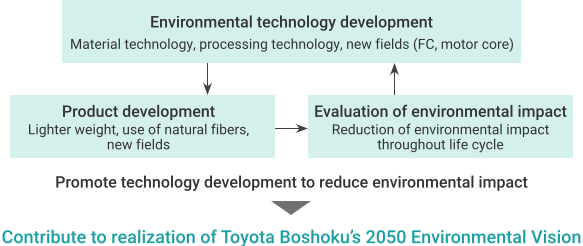
Future vision of Toyota Boshoku

- An energy system that does not rely on electricity and heat from only one energy source, and also uses CO2 emissions
Carbon Neutrality Strategy Roadmap
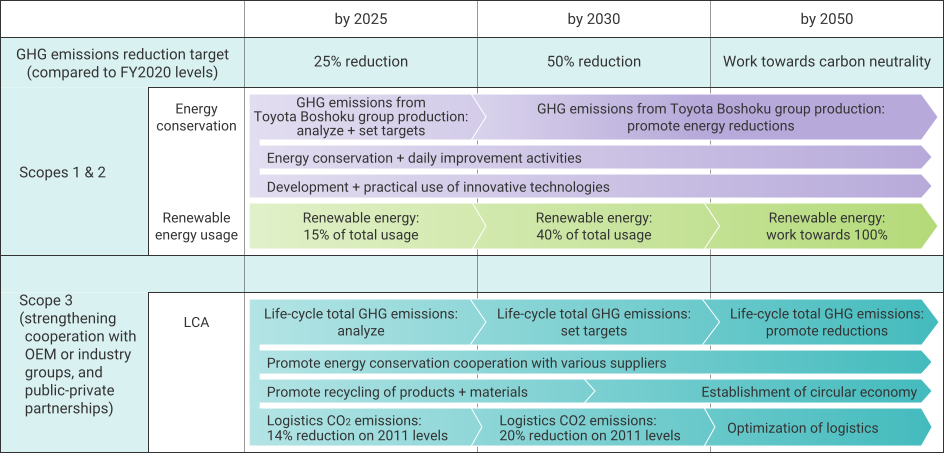
The Carbon Neutrality Strategy Roadmap is an action implementation plan designed to help us achieve our target of reducing plant GHG emissions by 50% (compared to FY2020 levels) by the year 2030. It was designed with consideration of the actual conditions on the ground across our five global regions of Japan, the Americas, China, Asia, and Europe & Africa. Working together with each region, we are working to examine which improvement items can, or should be implemented globally, and are promoting activities that contribute to the realization of our GHG target.
Reduce GHG Emissions in the Life Cycle of Toyota Boshoku Products by Reducing Weights
Toyota Boshoku ascertains GHG emissions in the life cycle of core products, from their manufacture and sale to their installation in vehicles, usage and eventual disposal, and then conducts life cycle assessment (LCA) to reduce these emissions as a means to promote more environmentally friendly products. Out of all the stages in the life cycle mentioned above, the majority of CO2 emissions arise during a product’s usage. Thus, we put great effort into actions that can improve fuel efficiency and reduce emissions, such as promotion of reductions to the size or weight of products.
Click here to learn more about Toyota Boshoku’s efforts to create door trims with high impact resistance and lower weight.
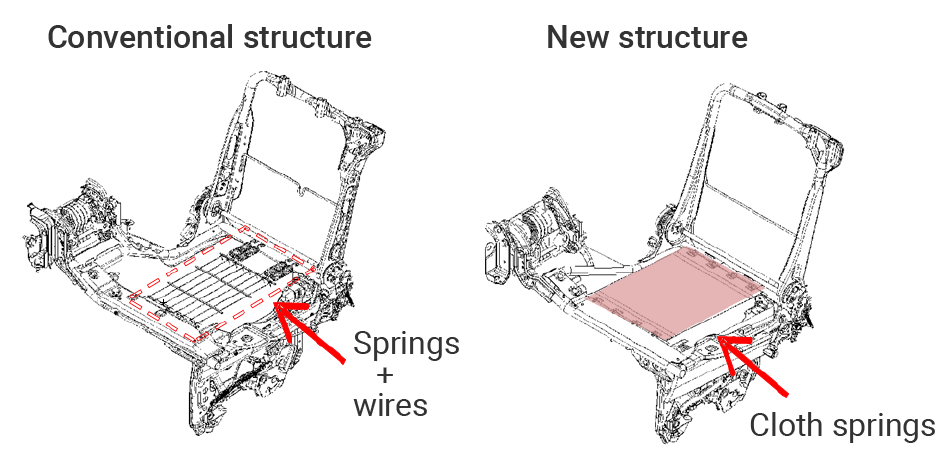
Reducing CO2 emissions through lightweighting
Since fiscal 2022, lower-profile, comfort-enhancing third-row seats were installed in Toyota's NOAH and VOXY models. The conventional metal springs and wires in the third-row seat cushioning have been replaced with fiber cloth springs, which allows improved comfort while riding, as well as thinner overall seating, leading to weight reduction.
Our Decarbonization School, Run by Sunshine (Toyota Boshoku suppliers' association)
Our Decarbonization School has been operating since fiscal 2023, with the aim of reducing GHG emissions throughout our entire supply chain.
The school holds lectures for members of our supply chain by both external consultants and staff from our Carbon Neutral Environment Center on energy saving techniques, Scope 3* initiatives, and other topics. It also assists member companies in creating GHG emission reduction targets, and in developing plans to meet their targets, as well as supporting employee development with an eye to cultivating employees with the skills and vision needed for long-term carbon neutral efforts.
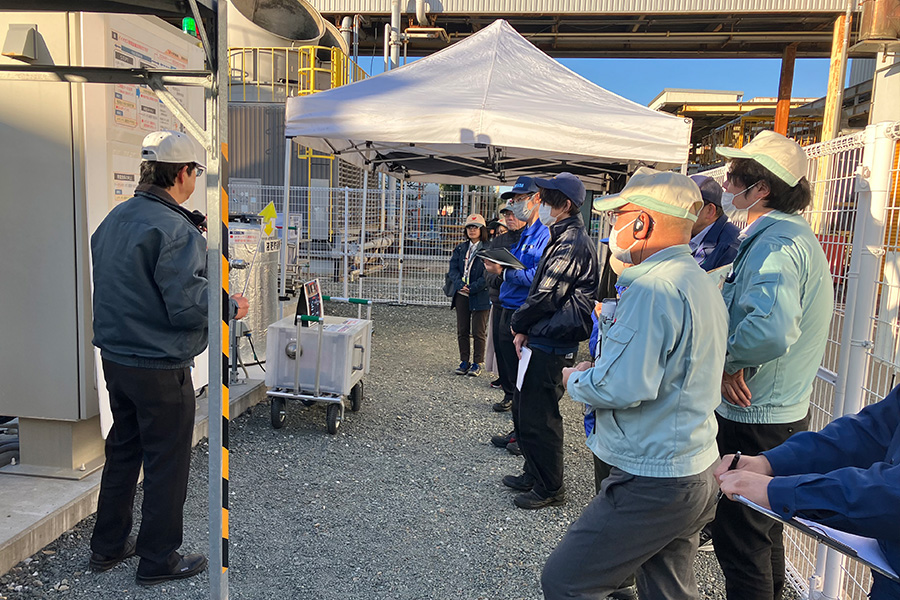
As well as classroom lectures, on-site study sessions were also held at the Kariya Plant in fiscal 2023, at Toyota Boshoku Shiga in fiscal 2024, and Toyota Boshoku Toyohashi-Kita Plant in fiscal 2025. At the plants, Toyota Boshoku introduced suppliers to daily methods for improvement, including Toyota Boshoku energy saving 40 items, equipment for power generation using leftover food, and storage battery equipment designed for effective use of renewable energy.
We will continue to work closely with our suppliers to promote carbon neutral initiatives throughout the supply chain.
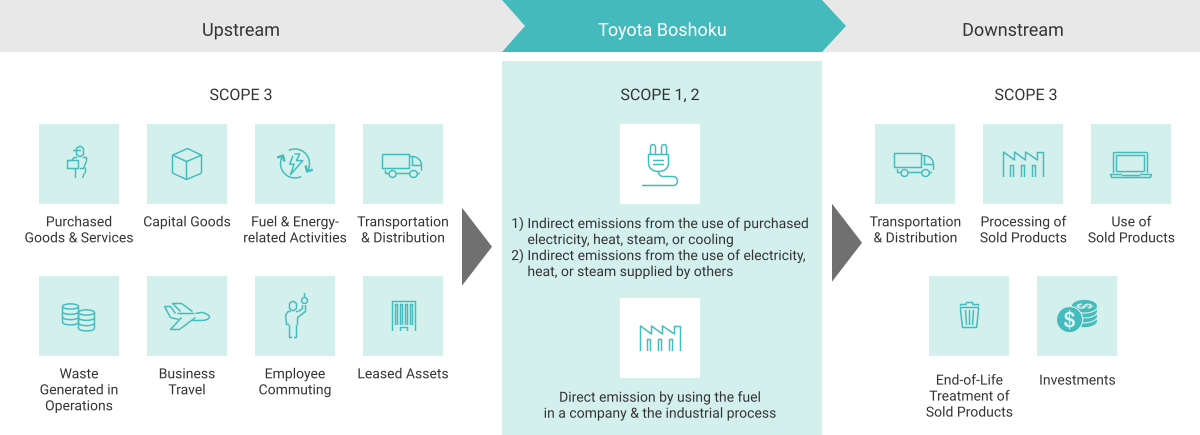
- GHG emitted through corporate activities both upstream (materials procurement and logistics, employee travel, etc.) and downstream (product use, disposal, etc.)
Scope 3 (Supply Chain Management)
Toyota Boshoku has commenced to calculate the GHG emission of whole Toyota Boshoku’s supply chain in order to reduce the GHG emission from our whole business activities since FY2013.
Next, we will improve the precision of calculating method, and proceed to reduce GHG emission after we evaluate the GHG emission of each category in our whole business activities.
Calculation categories
- Construction/production equipment, etc.
GHG emissions produced by Toyota Boshoku group's value chain
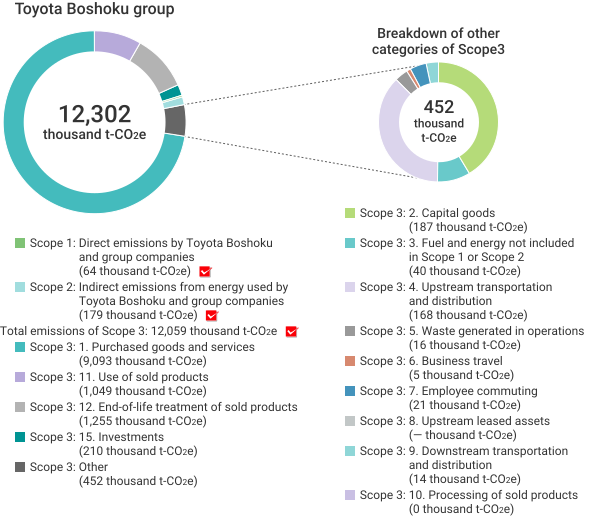
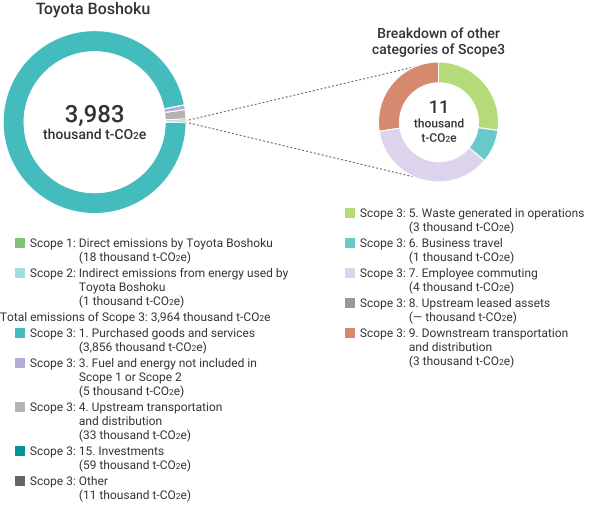
- Included in Scope 2
Calculation standards
| Category | Explanation of each category | Calculating method |
|---|---|---|
| 1. Purchased goods & services | Emissions from production of purchased raw materials, components, etc. | For raw materials, components, etc. purchased at Toyota Boshoku group production sites, figures are calculated by multiplying the costs (in million yen) of each type of raw material, component, etc. by GHG emission factor (t-CO2e/millions yen) by raw material type. GHG emission factors by raw material type values are taken from the separate emission factor database for corporate GHG emissions accounting over the supply chain (Ver. 3.5, March 2025) published by the Ministry of the Environment (MoE) and the Ministry of Economy, Trade and Industry (METI). For a portion of raw materials (resin materials) purchased by Toyota Boshoku figures are calculated by multiplying GHG emission factor by raw material type (t-CO2e/kg) × purchased amount (kg). GHG emission factors by raw material type uses values from “IDEAv3.5 IPCC2021 without LULUCF AR6” published by public research organization the National Institute of Advanced Industrial Science and Technology (AIST). |
| 2. Capital goods | Emissions from the construction and manufacture of the company’s own Capital goods (building & equipment, etc.) | For increased monetary value in the report year for fixed assets (buildings and structures, machinery and vehicles, tools, appliances and fixtures, software, etc.) held by Toyota Boshoku group, calculation is performed based on the “Basic Guidelines on Accounting for Greenhouse Gas Emissions Throughout the Supply Chain” (Ver. 2.7, March 2025) and the separate emission factor database for corporate GHG emissions accounting over the supply chain (Ver. 3.5, March 2025), both published by MoE and METI. |
| 3. Fuel- and energy-related activities not included in Scope 1 or Scope 2 | Emissions by producing and transporting the purchased fuel & manufacturing stage of purchased electricity and heat | For energy consumption by Toyota Boshoku group, calculation is performed based on the “Basic Guidelines on Accounting for Greenhouse Gas Emissions Throughout the Supply Chain” (Ver. 2.7, March 2025), the separate emission factor database for corporate GHG emissions accounting over the supply chain (Ver. 3.5, March 2025), both published by MoE and METI, and values from “IDEAv3.5 IPCC2021 without LULUCF AR6” published by AIST. |
| 4. Upstream transportation and distribution | Emissions from procurement logistics and shipping logistics of our shipments | CO2 of procurement logistics from suppliers to Toyota Boshoku group and shipping logistics of our shipments are calculated based on the “Basic Guidelines on Accounting for Greenhouse Gas Emissions Throughout the Supply Chain” (Ver. 2.7, March 2025), published by MoE and METI, ISO 14083:2023 (“Quantification and reporting of greenhouse gas emissions arising from transport chain operations”), the “Global Logistics Emissions Council (GLEC) Framework V3.0,” and “IDEAv3.5 IPCC2021 without LULUCF AR6” published by AIST. |
| 5. Waste generated in operations | Emissions from the disposal of waste generated in-house | Calculated by multiplying the amount of waste (t) discharged from Toyota Boshoku group offices and plants by the GHG emission factor for each waste type (t-CO2e/t). Values for GHG emission factors by waste type (t-CO2e/t) are from the “Basic Guidelines on Accounting for Greenhouse Gas Emissions Throughout the Supply Chain” (Ver. 2.7, March 2025) and the separate emission factor database for corporate GHG emissions accounting over the supply chain (Ver. 3.5, March 2025), both published by MoE and METI, the U.S. EPA “Emission Factors for Greenhouse Gas Inventories 2024,” “Thailand’s Emission Factor,” the “Indonesia_climate-change-roadmap-waste-sector” and the “UK Government GHG Conversion Factors for Company Reporting Ver.1.1.” |
| 6. Business travel | Emissions from business travel by company members | Calculation of distance (km) × GHG emission factor by automobile type (t-CO2e/km) or value of transportation expenses paid (yen) × GHG emission factor by transportation type (t-CO2e/yen) for Toyota Boshoku. GHG emission factors by automobile type uses values from “ IDEAv3.5 IPCC2021 without LULUCF AR6” published by AIST. GHG emission factors by transportation type values are taken from the separate emission factor database for corporate GHG emissions accounting over the supply chain (Ver. 3.5, March 2025) published by MoE and METI. Calculation by number of group employees (non-Toyota Boshoku) based on the “Basic Guidelines on Accounting for Greenhouse Gas Emissions Throughout the Supply Chain” (Ver. 2.7, March 2025) and the separate emission factor database for corporate GHG emissions accounting over the supply chain (Ver. 3.5, March 2025) published by MoE and METI. |
| 7. Employee commuting | Emissions from commuting by company members to and from the workplace | Calculation of distance (km) × GHG emission factor by automobile type (t-CO2e/km) or value of transportation expenses paid (yen) × GHG emission factor by transportation type (t-CO2e/yen) for Toyota Boshoku. GHG emission factors by automobile type uses values from “IDEAv3.5 IPCC2021 without LULUCF AR6” published by AIST. GHG emission factors by transportation type values are taken from the separate emission factor database for corporate GHG emissions accounting over the supply chain (Ver. 3.5, March 2025) published by MoE and METI. Calculation by number of group employees (non-Toyota Boshoku) and number of business days, based on the “Basic Guidelines on Accounting for Greenhouse Gas Emissions Throughout the Supply Chain” (Ver. 2.7, March 2025), the separate emission factor database for corporate GHG emissions accounting over the supply chain (Ver. 3.5, March 2025), both published by MoE and METI. |
| 8. Upstream leased assets | Emissions from the operation of assets leased by our company (Except when calculated in Scope 1 and 2) | Amounts for GHG emissions from upstream use of leased assets (vehicles, building rental, etc.) are included in Scope 1 and 2. |
| 9. Downstream transportation and distribution | Emissions from logistics to customers (excluding shipping logistics of our shipments) | For logistics from Toyota Boshoku group to customers, calculation is performed based on the “Basic Guidelines on Accounting for Greenhouse Gas Emissions Throughout the Supply Chain” (Ver. 2.7, March 2025), published by MoE and METI, ISO 14083:2023 (“Quantification and reporting of greenhouse gas emissions arising from transport chain operations”), the “Global Logistics Emissions Council (GLEC) Framework V3.0,” and “IDEAv3.5 IPCC2021 without LULUCF AR6” published by AIST. |
| 10. Processing of sold products | Emissions from intermediate product processing by customers | For products sold by Toyota Boshoku group, calculation is performed based on the “Basic Guidelines on Accounting for Greenhouse Gas Emissions Throughout the Supply Chain” (Ver. 2.7, March 2025), published by MoE and METI, while energy consumption by business partners, etc. uses emission factors from actual measurements at similar facilities of Toyota Boshoku. |
| 11. Use of sold products | Emissions from use of products by users (consumers) | For electrical components attached to products sold by Toyota Boshoku group, calculation is performed based on basic units calculated in-house for electrical components, the “Basic Guidelines on Accounting for Greenhouse Gas Emissions Throughout the Supply Chain” (Ver. 2.7, March 2025), published by MoE and METI, the LCI Calculation Guidelines (Consumer Use Phase) of general incorporated foundation the Japan Auto Parts Industries Association (JAPIA) (ver. 2.0.8, May 28, 2021), and the "list of calculation methods and emission factors in the calculation, reporting and publication system (2015)" of MoE. |
| 12. End-of-life treatment of sold products | Emissions from processing at time of product disposal by users (consumers) | For products sold by the Toyota Boshoku group, calculation is performed by multiplying units produced in categories of seats, interior and exterior parts, and unit components by basic units calculated in-house. Basic units calculated in-house are calculated based on fiscal 2020 shipment figures for the categories of seats, interior and exterior parts, and unit components. |
| 15. Investments | Investment management-related emissions | For Toyota Boshoku group affiliates accounted for by the equity method (20 companies), calculation is performed based on the “Basic Guidelines on Accounting for Greenhouse Gas Emissions Throughout the Supply Chain” (Ver. 2.7, March 2025) published by MoE and METI, by multiplying each company’s fiscal 2025 sales revenue by ownership ratio (%) and emission factors, the values for which are given in the separate emission factor database for corporate GHG emissions accounting over the supply chain (Ver. 3.5, March 2025), both published by MoE and METI. |
GHG emissions data that has been assured by an independent assurance provider is marked with this  assurance symbol (click here for details).
Inherent limitations in measurement and evaluation of environmental performance data
GHG emissions quantification is subject to uncertainty when measuring activity data, determining emission factors, and considering scientific uncertainty inherent in the Global Warming Potentials. Hence, the selection of a different but acceptable measurement method, activity data, emission factors, and relevant assumptions or parameters could have resulted in materially different amounts being reported.
Reducing CO2 emissions in logistics
We carry out logistics kaizen activities as part of our daily administrative tasks, and work together with plants to promote CO2 reductions by way of responding flexibly to daily changes in production. Within Japan, we are planning future expansion of joint logistics, as well as an associated reorganization of logistics transfer points, and are proceeding with both logistics optimization and further reductions in CO2 emissions.
In line with this work across Japan, we are also continuing to carry out change globally via implementation of logistics kaizen, and CO2 reduction activities across the world.
In the future we will actively investigate and consider the use of vehicles such as fuel cell vehicles and battery electric vehicles, as well as industrial machinery that does not rely on fossil fuels, and contribute towards realizing a carbon neutral future.
CO2 emissions in logistics [Toyota Boshoku]
![Graph:CO2 emissions in logistics [Toyota Boshoku]](/_assets/img/sustainability/environment/challenge/CO2/img5_01@global.svg)