





GHG Net-Zero in the Plant
Basic Approach
In pursuit of the GHG Net-Zero in the plant, as described in our 2050 Environmental Vision, we are promoting various environmental activities with the aim of reducing GHG emissions by 50% by the year 2030 (compared to FY2020 levels), and reducing GHG emissions by 100% by the year 2035.
Efforts to Achieve Carbon Neutrality
1. Promotion of initiatives to ensure completion of Toyota Boshoku energy saving 40 items
Toyota Boshoku group has been advancing energy conservation activities, with many energy saving initiatives being discussed, shared, and expanded across our business, but it is clear that more remains to be done in our workplaces, including plants. To address this, we have selected 40 specific energy saving items to be prioritized globally. These items can be divided into two categories: E-JIT* initiatives, which can be implemented through behavioral and workflow changes without additional financial cost, and equipment efficiency improvements, which involve either adoption of highly efficient equipment, or retrofitting of pre-existing facilities.
Additionally, we are working on developing and distributing both a manual for how to approach such improvements, and a mid-term activities plan to guide our future energy savings activities.
- Energy Just-In-Time (generating only the amount of energy that is required at that point in time to produce the necessary quantity of products)
Toyota Boshoku energy saving 40 items
| Category | Equipment/Machinery | No. | Item |
|---|---|---|---|
| E-JIT | Boilers | 1 | Closing nearby valves in unneeded areas |
| 2 | Regulation of boiler air ratios | ||
| 3 | Periodic steam trap inspections, diagnosis of issues | ||
| 4 | Thorough maintenance to prevent steam leaks | ||
| 5 | Thermal insulation of pipes & valves | ||
| 6 | Removal of unneeded pipes | ||
| Air conditioning | 7 | Periodic cleaning of filters & heat exchange fins | |
| 8 | Consistently turn off when unneeded | ||
| 9 | Use of timers to automatically switch units off | ||
| 10 | Adherence to temperature regulations | ||
| Lighting | 11 | Use of natural lighting (skylights) | |
| 12 | Removal of unneeded lighting | ||
| 13 | Turning off unnecessary/excessive lighting | ||
| 14 | Switching off lighting when unneeded | ||
| Compressors | 15 | Closing nearby valves in unneeded areas | |
| 16 | Thorough maintenance to prevent air leaks | ||
| 17 | Periodic cleaning of filters | ||
| Fans & pumps | 18 | Carrying out periodic cleaning of strainers | |
| 19 | Coupling fans & pumps with production equipment | ||
| Other | 20 | Consistently turn off power outside production times | |
| 21 | Systematically switching off power when not needed |
| Category | Equipment/Machinery | No. | Item |
|---|---|---|---|
| Equipment Efficiency Improvements | Boilers | 22 | Ending use of large-scale boilers in factories |
| 23 | Heat recovery via economizers | ||
| 24 | Installation of boiler control units | ||
| Air conditioning | 25 | Switching to highly efficient air conditioners | |
| 26 | Switching to insulated, heat-reflective glass in equipment buildings | ||
| Lighting | 27 | Switching to LED lighting | |
| Compressors | 28 | Installation of inverter air compressors | |
| 29 | Installation of air tanks | ||
| 30 | Installation of compressor control units | ||
| 31 | Converting to ring main water piping | ||
| 32 | Switching from air cylinders to electric cylinders | ||
| 33 | Converting to electric blowers | ||
| 34 | Converting to highly efficient air blow guns | ||
| Fans & pumps | 35 | Automatic operation of fans & pumps via coolant temperature-sensing inverter control systems | |
| 36 | Reducing water usage by switching pumps to inverter control systems | ||
| 37 | Regulating ventilation by switching fans to inverter control systems | ||
| 38 | Use of highly efficient machinery | ||
| Other | 39 | Heat insulation of hydronics equipment | |
| 40 | Switching to highly efficient, best-in-class transformer models |
2. Active introduction of renewable energy
Toyota Boshoku group is promoting energy conservation activities while simultaneously working to switch over to renewable energy. There are various means available, including installation of solar panels and purchase of the environmental value of externally-generated renewable energy. Furthermore, by combining various forms of renewable energy, we aim for stable procurement of energy with lower environmental impact.
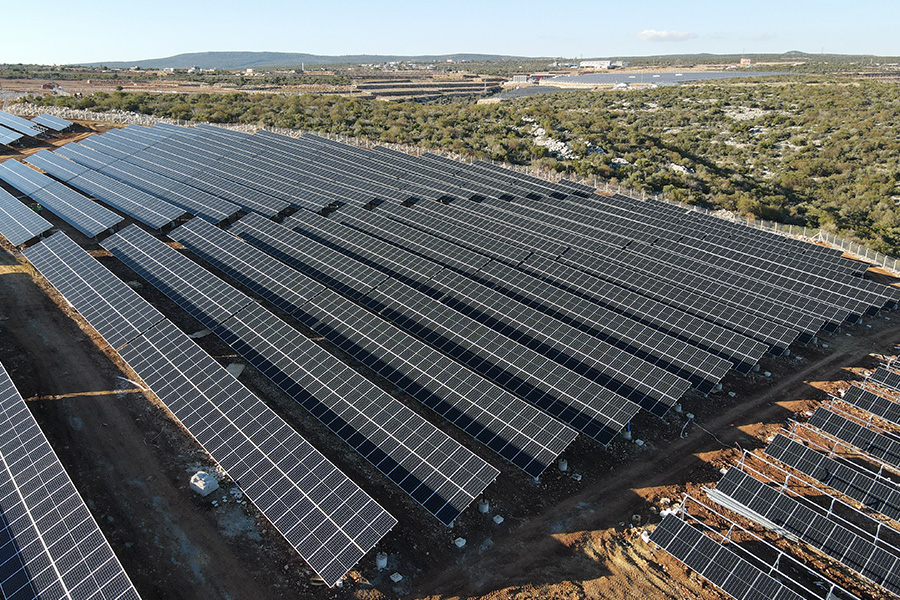
In one such initiative, Toyota Boshoku Turkiye and TB Sewtech Turkey constructed a solar power generation facility in 2024. As a result, both companies will be able to cover all of their electricity demand through renewable energy generated in-house, and we expect to reduce CO2 emissions by approximately 5,800 tons per year.
The amount of CO2 emissions reduction* through the introduction of renewable energy [Toyota Boshoku group]
![Graph:The amount of CO2 emissions reduction* through the introduction of renewable energy [Toyota Boshoku group]](/_assets/img/sustainability/environment/challenge/CO2/img2_3_01@global.svg)
- We calculate the amount of CO2 emissions reduction by multiplying the amount of renewable energy introduced at group business sites by the CO2 conversion factors of electricity described below under “Calculation of greenhouse gas emissions.”
Calculation of greenhouse gas emissions
CO2 conversion factors for electric power in Japan are calculated with reference to emissions factors from each domestic electric utility company (based on emissions survey results), and included in Electric Utility Companies’ Emissions Factors (for use in calculating greenhouse gas emissions of companies emitting above a certain set level)-Results from Fiscal 2024, published by Japan's Ministry of the Environment, whereas for electric power in regions outside of Japan are calculated with reference to the International Energy Agency's (IEA) Emissions Factors 2024.
CO2 conversion factors for gas and other fuels are calculated with reference to A Summary of Calculation Methods and Emission Intensities for Systems of Calculating, Reporting and Publishing Environmental Data published by Japan’s Ministry of the Environment.
Introduction of storage batteries
At our Toyohashi-Kita Plant, we have installed storage batteries to efficiently utilize the electricity generated by the solar generation equipment on the roof. When the generated electricity exceeds immediate consumption, it is stored in the batteries. During peak usage times, the stored electricity is discharged, thereby improving the utilization rate of solar power generation. This approach not only achieves peak shifting but also promotes effective energy use.